
Is RCS the future of business messaging? Compare SMS and RCS to find out which solution works best for your brand.
For digital marketers and brands seeking to maximize customer engagement, two messaging protocols stand at the forefront: the venerable SMS and its modern successor RCS for Business. Understanding the distinction between the two isn't just technical knowledge—it's a strategic advantage.
While you're familiar with SMS campaigns, RCS for Business represents a powerful evolution that'll reshape how businesses connect with consumers through mobile messaging.
SMS has been the backbone of text messaging since the early 1990s. Its simplicity and ubiquity have made it the most widely used messaging technology in history. And was widely adopted by businesses looking to communicate on a more personal channel with their customers in the early 2000s.
Continuing to build on this foundation, RCS represents the next generation of messaging for the smartphone era. Though introduced in 2008, it has only recently gained significant traction. RCS brings messaging into the modern age, across operating systems, with rich media sharing, read receipts, typing indicators, enhanced group chats, and business messaging features—which will let brands engage and convert customers in new ways.
As we dive deeper into these technologies, we'll explore how they compare in functionality, user experience, business applications, and what the future holds for mobile messaging.
Understanding the difference: SMS vs. RCS
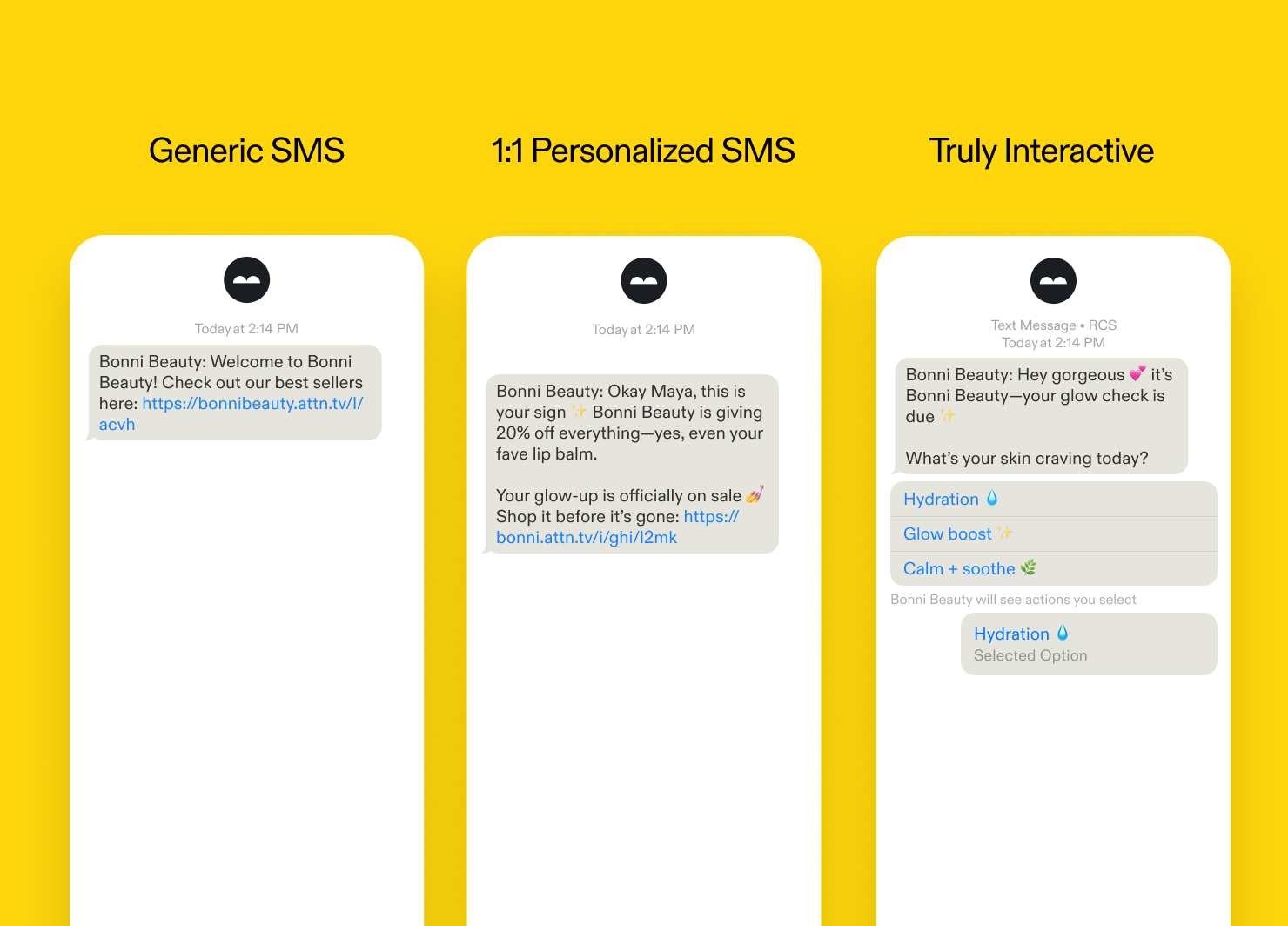
The distinction between SMS and RCS for Business directly impacts bottom-line results. While SMS offers reliable reach with basic text-only messages, RCS for Business transforms mobile messaging into a rich shopping channel with product galleries, interactive buttons, and seamless checkout experiences.
What is SMS?
SMS, or Short Message Service, is a type of text message that doesn't include images, videos, or GIFs, and is limited to 160 characters. SMS messages are sent via the carrier network, meaning you don’t need a Wi-Fi connection to send and receive messages.
Advantages
Despite the evolution of digital marketing channels, SMS continues to deliver exceptional results for brands. With near-universal reach across virtually every mobile device, extraordinary open rates approaching 98%, and the ability to deliver messages instantly regardless of data connectivity, SMS provides marketers with a connection to customers on their most personal devices.
Its simplicity eliminates technical barriers, while its cost-effectiveness makes it accessible to businesses of all sizes. For time-sensitive promotions, urgent updates, or reaching customers in areas with limited connectivity, SMS remains the most reliable channel for ensuring your message not only reaches your audience but actually gets seen—often within minutes of sending.
Limitations
While SMS marketing offers unmatched reach and open rates, its fundamental limitations can constrain modern marketing strategies.
The restrictive 160-character format forces marketers to communicate in the most basic text-only format, eliminating any possibility for visual product showcasing, brand imagery, or interactive elements that drive engagement. Without the ability to include images, videos, or clickable buttons, SMS messages struggle to create compelling shopping experiences or seamless conversion paths.
As consumer expectations evolve toward rich, visual, and interactive mobile experiences, these technical constraints of SMS can make messages feel outdated and impersonal, potentially leading to higher opt-out rates and diminished effectiveness for brands seeking to create distinctive and engaging customer experiences.
What is RCS for Business?
Rich Communication Services (RCS) for Business is a messaging protocol designed to enhance mobile messaging with features like multimedia sharing, branded sender IDs, and interactive communication. RCS operates over data networks and requires both compatible devices and carrier support.
Advantages
As retail increasingly moves online and mobile commerce continues to grow, the rich, interactive nature of RCS for Business addresses many of the limitations retailers face with traditional SMS campaigns while creating new opportunities for driving revenue through the messaging channel.
This evolution translates to measurable benefits like:
- Higher conversion rates (20-35% improvements in some cases)
- Reduced cart abandonment
- Improved post-purchase experiences that build loyalty
- Enhanced security in supported environments with end-to-end encryption
- Verified business sender IDs for building trust and security
Retailers who use RCS for Business's rich capabilities can create personalized shopping journeys, showcase products visually, and provide interactive assistance directly through messaging. In our latest consumer survey, 90% of consumers are more likely to make a purchase when interacting with a brand using at least one RCS feature.
Limitations
While RCS for Business represents a significant evolution from traditional SMS, marketers should approach with measured expectations. With all major carriers now supporting RCS for Business and the vast majority of consumers able to receive RCS messages, the technology has reached impressive maturity. However, there will always be specific situations where a small portion of subscribers can't receive RCS messages.
- Internet dependency limitations: RCS for Business requires an active internet connection, meaning a small portion of subscribers may be unable to receive messages at any given time — whether due to an older incompatible device, being mid-flight, or other connectivity edge cases. The good news is that SMS serves as a seamless fallback solution for these instances, ensuring your message still reaches every subscriber regardless of their RCS eligibility.
These limitations, though minimal for most campaigns, are worth considering when integrating RCS for Business into a brand's communication strategy. With SMS as a built-in safety net, marketers can confidently lean into RCS capabilities without sacrificing reach.
How businesses use RCS and SMS
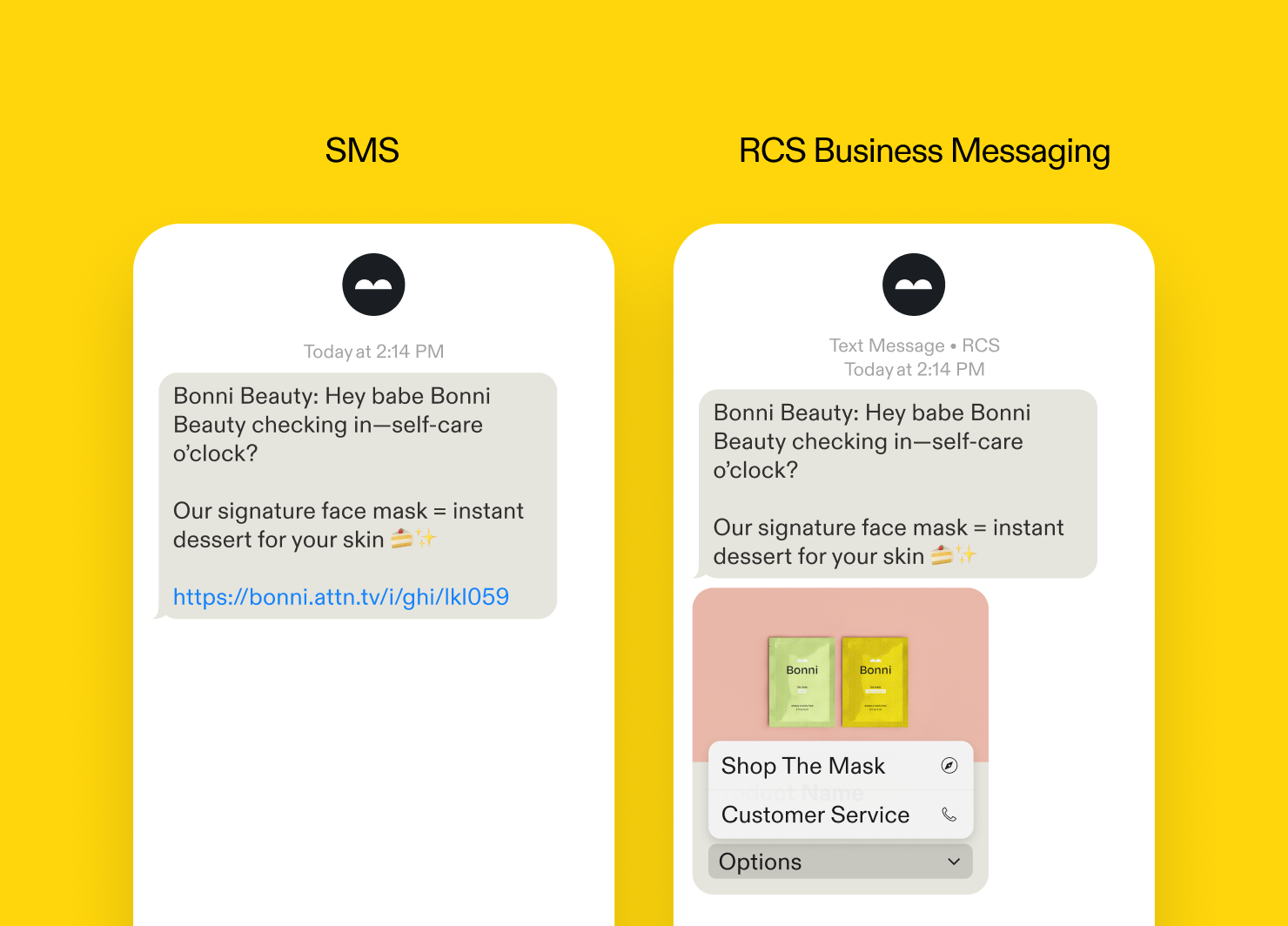
The question is, is one messaging format better than the other? Both will continue to be incredibly effective methods for communicating with your customers. Here are some best practices and examples of when to use each.
RCS Use Cases
RCS for Business has reached widespread adoption, and early results are impressive—both brands and consumers are responding enthusiastically to the enhanced messaging experience. So where does it make the most sense to use RCS over SMS? Start with moments where you want to level up your personalization capabilities and make a lasting impression with your shoppers.
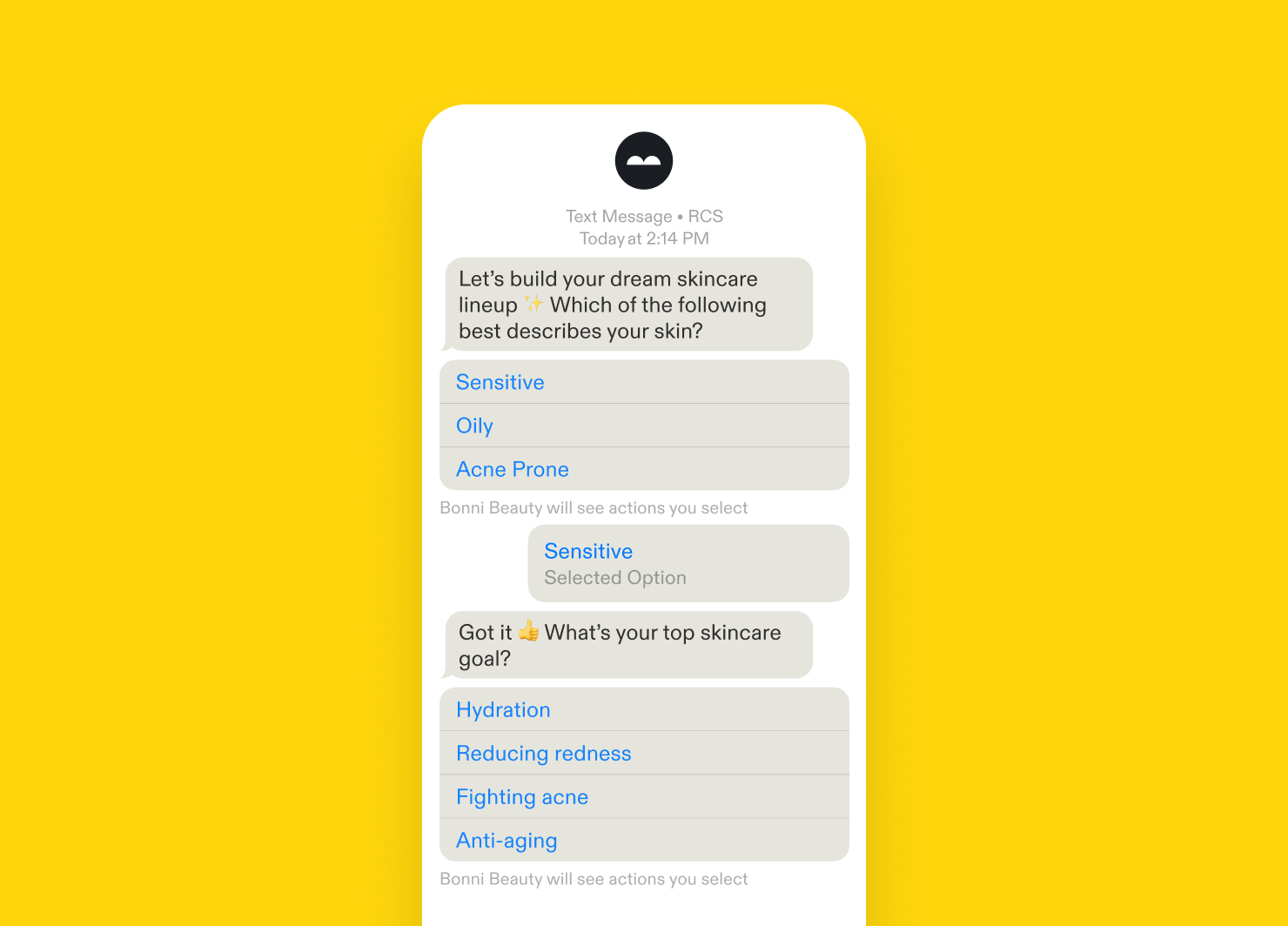
Suggested replies
RCS for Business takes conversational commerce to a whole new level. Integrated action buttons within rich media cards or as standalone elements streamline user interaction, allowing for effortless responses to visual content or seamless navigation to web pages and applications with a single tap.
Branded messages
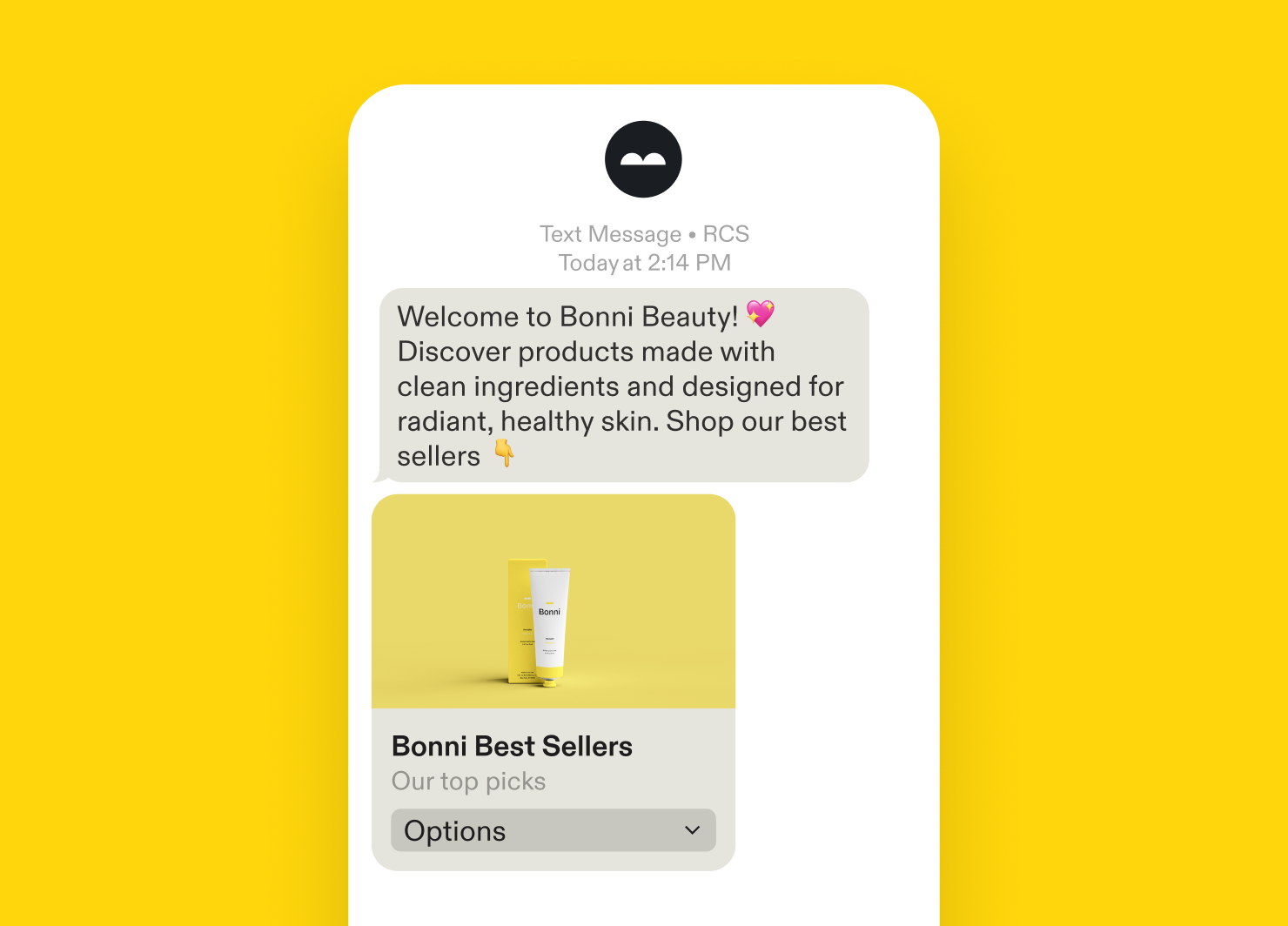
Companies can keep brand consistency by embedding brand elements such as name, logo, and colors on screen without needing a contact card. In addition, every brand using RCS for Business is verified by Google. This level of verification gives subscribers trust in the messages they receive, which may increase CVRs.
SMS Use Cases
There are a couple of scenarios where we may recommend using SMS over RCS for Business. For example, urgent messages you want your customers to see, like shipping updates or delays. If you’re a sports team, SMS is a great way to update your fans on any game day changes. Or maybe you need to communicate with your entire subscriber list and SMS will ensure the message reaches the most people.
Broad-reach marketing campaigns
As carriers ramp up, you may want to consider using SMS for your marketing campaigns meant to target a larger portion of your subscriber list. Think popular promotional periods that happen around holidays.
Will RCS replace SMS?
The world will shift to RCS as the default, but this evolution will take significant time. SMS/MMS aren't going anywhere, but will see usage decline over time.
Here’s what we know, Google has been at the forefront of driving RCS adoption globally, transforming what began as a carrier-led initiative into a significant ecosystem push. Recent statistics show that Google's efforts have helped RCS reach over 1 billion monthly active users globally as of late 2024, demonstrating substantial growth from just 444 million users in 2022. But there is still a lot of work to be done.
SMS will remain relevant despite RCS advancements
Rather than a complete replacement, SMS and RCS for Business will coexist for the foreseeable future. And that's actually a strategic advantage for marketers.
SMS's staying power isn't about technical limitations with RCS—today, RCS offers the same level of compatibility across devices and carriers. Instead, SMS's advantage lies in its deep roots: after 30+ years in the ecosystem, it's universally understood, instantly trusted, and built into every workflow. That established presence makes it invaluable for communications that prioritize simplicity and familiarity.
The division between channels will likely evolve over time. Today, SMS dominates for straightforward transactional messaging, two-factor authentication, and alerts, while RCS shines for rich marketing communications, interactive customer service, and conversational commerce. But as RCS continues to mature and consumer familiarity grows, we'll likely see some use cases—like certain types of alerts—gradually transition to RCS. That said, highly sensitive functions like 2FA will probably remain in SMS's domain for years to come, given the deeply ingrained trust and reliability expectations around those critical moments.
The Attentive POV
Looking ahead, the messaging landscape will likely evolve in several key directions:
- RCS for Business will increasingly integrate with AI tools, creating more sophisticated automated customer interactions. The rich media capabilities of RCS for Business provide visual information, interactive forms, and guided processes that will significantly enhance the customer experience compared to text-only SMS interactions.
- Marketing automation platforms will evolve to orchestrate campaigns across both SMS and RCS for Business channels, intelligently routing messages based on user device compatibility, message content requirements, and engagement history. This hybrid approach will maximize reach while leveraging RCS for Business capabilities where available.
- Omnichannel strategies will incorporate RCS for Business as a premium messaging channel within broader communication ecosystems. It will function as a bridge between traditional text messaging and full-featured apps, particularly for brands that struggle with app adoption or retention.
- Analytics and measurement capabilities will advance to provide unified insights across SMS and RCS for Business channels, helping marketers understand performance differences and optimize their messaging strategy accordingly.
- Vertical-specific RCS for Business solutions will emerge for industries like healthcare (appointment management), retail (conversational commerce), travel (interactive itineraries), and financial services (secure transaction authorizations), driving adoption in these sectors ahead of others.
As these trends develop, we'll likely see RCS gradually increase its share of business messaging while SMS maintains a fundamental role in the communications ecosystem—the two technologies complementing rather than replacing one another for the foreseeable future.
As consumers increasingly expect seamless mobile experiences, businesses that master the strategic deployment of both SMS and RCS for Business position themselves to capture attention, drive conversions, and differentiate their brand.

.png)