

The right SMS marketing platform turns customer conversations into revenue. Learn about the top options to find the platform that best fits your needs.
Choosing an SMS marketing platform is a high-leverage decision you can make to improve customer retention and revenue. The right SMS marketing services will help you grow a healthy subscriber list, run high-performing SMS campaigns, and deliver personalized text messages at scale—ultimately letting you build lasting customer relationships and drive meaningful revenue.
There are plenty of options to choose from—from all-in-one marketing platforms to dedicated SMS tools. It helps to start with a clear set of criteria so you can choose the SMS marketing platform that's the best fit for your business—both now and as you grow.
Whether you’re looking to tap into the power of SMS marketing for the first time or level up an established SMS marketing program, this guide compares today’s top SMS platforms so you can choose with confidence—and send the right text messages for every moment in the customer journey.
How to shortlist the best SMS marketing software
If you’re comparing the best SMS marketing software, you’ll want to choose a solution with the right features to support your brand’s unique needs and objectives. On this list, you’ll find several text marketing platforms that are a better fit for specific requirements.
If you have a deep e-commerce focus, you’ll want to prioritize identity resolution, segmentation, and onsite capture tools that make text marketing easier and help boost engagement.
For advanced SMS marketing strategies, the best SMS marketing software should include SMS automation, strong analytics, flexible workflows, and sophisticated AI-powered personalization capabilities. Then you can ensure sending SMS messages stays efficient as volume grows.
For a small business, the best SMS marketing software is the one that helps you grow SMS subscribers and send effective text messages without too much complexity, but will allow you to scale to more advanced use cases as your company grows. It should include ready-to-go integrations so you don’t have to mess around with custom workflows, fast onboarding, and prioritize ease of use. And it should offer a clear path from starter SMS marketing services to more advanced SMS functionality.
Key features to consider when choosing an SMS platform
With your company’s SMS marketing strategy and goals in mind, you’ll want to choose an SMS marketing platform with the right features to support your brand. Use this checklist to evaluate each vendor’s SMS marketing software.
Here are the essential features we recommend considering in an SMS service:
- iOS 26-ready list growth capabilities: As a baseline, your SMS marketing platform should make it easy to collect phone numbers and grow a healthy subscriber base from different places—like your website, email, social media, and in-person interactions. With the release of iOS 26, SMS marketing programs also benefit from platforms with features—like Attentive’s patented two-tap™ sign-up technology—that put your brand in shoppers’ primary inbox from the start.
- Identity resolution and subscriber recognition: Behavioral messages are a primary source of SMS revenue for most brands. They work best when your text marketing platform can accurately identify on-site subscribers across browsing sessions and devices—then tie behavior back to customers’ phone numbers for smarter triggered text messages. Look for an SMS marketing platform that uses multiple forms of identification and server-side tracking to build comprehensive customer profiles for more attuned triggered text messages.
- Advanced messaging capabilities: Beyond basic promotional SMS and bulk SMS sends for high-volume announcements, your platform should offer SMS and MMS formats—and be working toward RCS for Business capabilities. The best SMS marketing platform will enable you to schedule messages and send dynamic triggered flows like welcome messages and cart abandonment reminders. And it would offer two-way messaging to engage subscribers and build out their customer profiles for more nuanced personalization.
- AI and automation that improve performance: Essential SMS marketing automation features will let you engage potential customers with behavioral flows, route subscribers into audience segments, confirm opt-in, and schedule campaigns. AI takes it to the next level by enabling marketers to improve their results beyond what humans can do alone. An SMS marketing platform with sophisticated AI capabilities can help automate copywriting, build dynamic segments, and optimize campaigns and behavioral flows to increase engagement and conversion rates—all while staying true to your brand.
- Deliverability you can trust: You need to trust that your messages will reach your subscribers consistently—especially during high-volume sending times like Black Friday/Cyber Monday (BFCM). Look for an SMS marketing platform with a strong delivery network and robust infrastructure to ensure your messages get delivered—especially when you’re trying to communicate time-sensitive reminders and urgent updates.
- Compliance expertise: SMS is a regulated channel with strict rules and requirements. Your SMS provider should be well-versed in compliance laws like the TCPA, GDPR, and CCPA and offer built-in tools to help you stay compliant. As a baseline, an SMS tool should help you collect opt-in consent by default, include clear opt-out instructions, and abide by local sending quiet hours (Attentive’s recommended quiet hours are 8pm to 12pm ET).
- RCS ready: Rich Communication Services (RCS) is the next generation of messaging that will deliver highly engaging experiences via text, including preference sharing through Suggested Replies and Actions, browsable product carousels, add-to-cart, and more—right in customers’ text messaging app. Early RCS results are showing significant boosts to engagement and revenue.
- Sophisticated personalization: 71% of consumers want brands to learn from their shopping habits over time. Look for personalization tools that make it easy to use your customer data across flows, triggers, segments, and automation features.
- Flexible integrations: Your SMS marketing platform should work seamlessly with any other tools that house customer data—like your CRM, e-commerce platform, loyalty provider, ESP (if you don’t opt to combine your programs), and CDP. Strong integrations will make it easier to keep contact lists up to date and unify contact management across your marketing platforms. The goal is to integrate SMS into your broader marketing efforts so you can activate your data effectively for a cohesive customer experience.
- Comprehensive analytics: It should be easy to understand how your SMS marketing program is performing so you can make data-driven decisions. Look for intuitive dashboards with a clean user interface, real-time performance insights, and flexible SMS analytics to focus on the SMS marketing metrics that matter most to your brand.
- International reach: If you have global customers, verify the platform you choose supports messaging in the countries your subscribers are based in and can help you comply with local regulations.
- Expert guidance and support: The right SMS marketing tech partner will offer strategic support beyond the software, helping you implement best practices and optimize your program over time. Bonus if they have a resource hub or knowledge base to help you level up and make the most of the platform's features.
The strongest SMS marketing programs are built on a platform that grows with them. As you compare your options, look for the capabilities and partnership that will support you as your program expands and your ambitions get bigger.
At a glance: The best SMS marketing platforms
Now that you know what you’re looking for in a solution, here’s a quick comparison of the top SMS marketing tools to support your strategy across the customer lifecycle—including options that work well for enterprise teams, small businesses, e-commerce, brick and mortar, and advanced marketing use cases.
A detailed look: 7 top SMS marketing platforms
Each SMS marketing platform brings a different set of strengths to the table—from how it handles identity and personalization to deliverability, compliance support, and cross-channel coordination.
Compare the core capabilities of these seven leading SMS marketing tools to your brand’s needs. From enterprise-grade solutions with advanced AI to simple Shopify-specific platforms, this detailed analysis will help you identify which solution aligns with your brand's specific needs, technical resources, and growth plans.
Attentive SMS review
Attentive is a leading mobile-first marketing platform trusted by more than 8,000 global brands to deliver exceptional results across SMS, email, and push. Named to Forbes’ Cloud 100 for five years running and recipient of a 2024 Merit Award for Best AI Application in Retail, we’re built to help brands turn messaging into a primary revenue channel.
As customer expectations rise, our continued investment in innovation enables true 1:1 personalization powered by AI, leading brands to:
- 25% more subscriber opt-ins and 35% more welcome series revenue thanks to AI-powered sign-up units
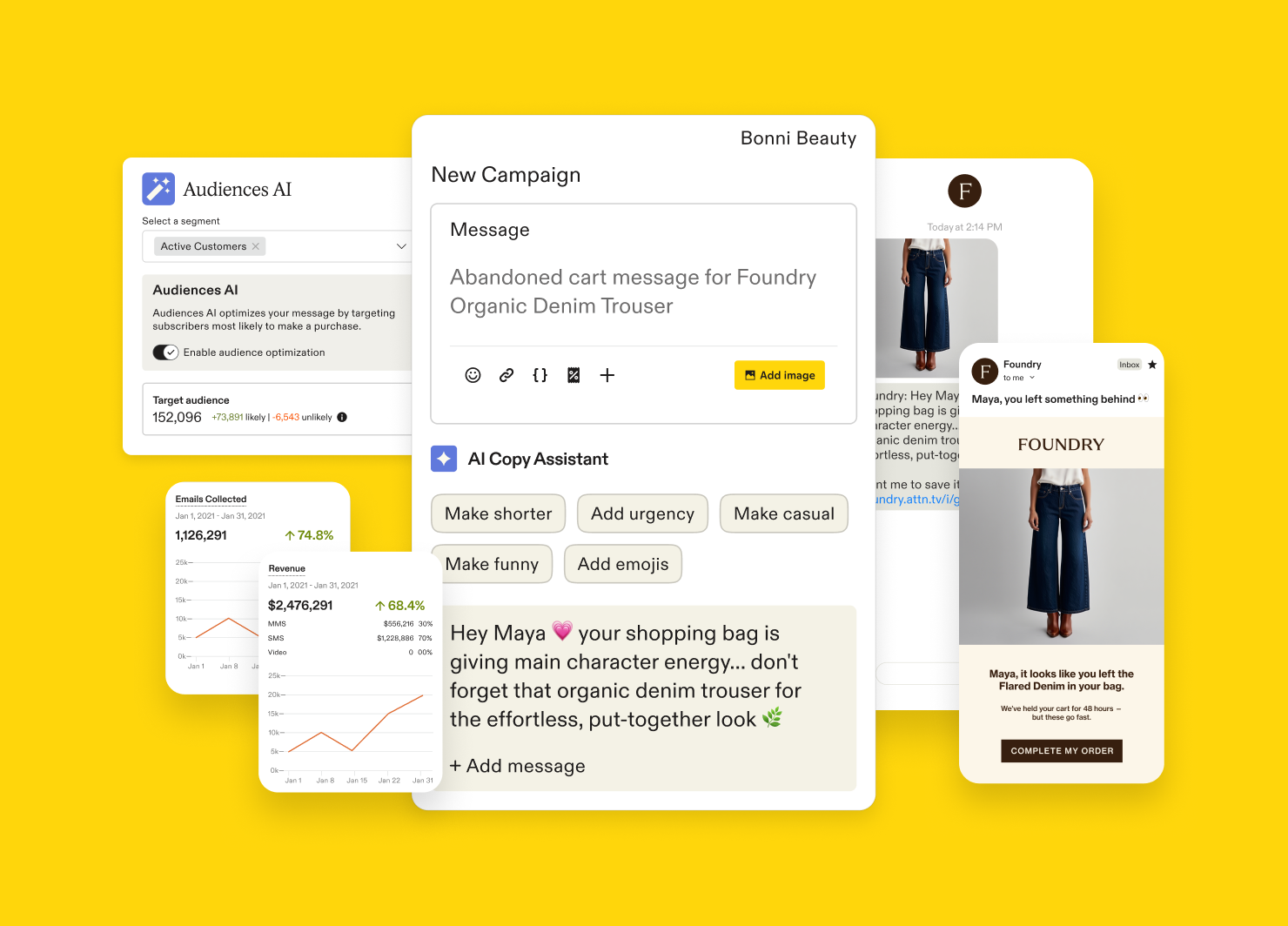
- 20% boost in multi-channel campaign revenue through AI-optimized segmentation
- 15–20% lift in abandonment journey revenue for text and email through smart identity resolution
And we’re pioneering RCS Business Messaging in the US to help brands maximize engagement.
Key differentiators
Attentive combines powerful technology with strategic expertise to help brands maximize their messaging performance and gain a competitive edge in customer engagement:
- Leading identity resolution and subscriber recognition: Attentive Signal uses multiple forms of identification and server-side tracking to accurately recognize customers across devices and browsing sessions for more detailed customer profiles, better targeting, and more personalized experiences.
- Unified messaging: Our platform helps you coordinate cohesive multi-channel campaigns and flows on SMS, email, and push that adapt to individual engagement patterns and maximize impact. And push notifications are on the way.
- Best-in-class AI capabilities: Attentive AI™ transforms how brands connect with customers by enabling true 1:1 personalization that boosts performance. It combines customer, product, and brand data to craft personalized messages that match each subscriber’s unique journey with your brand. With Attentive AI™, you can personalize the content, timing, and tone of behavioral flows and campaigns to reach each subscriber with the right message at the right time.
- Enterprise-grade deliverability: We’ve invested in a robust infrastructure and phone carrier partnerships to ensure reliable SMS delivery—even during high-volume sending periods like BFCM.
- Industry-leading compliance expertise: Our in-house legal team, which includes TCPA (Telephone Consumer Protection Act) specialists, ensures platform compliance. Our comprehensive built-in SMS compliance tools include audit trails for TCPA defense, automatic opt-out keyword recognition, fuzzy opt-out detection, and accessibility-focused sign-up units with proper color contrast and keyboard navigation. Attentive’s Litigator Defender automatically suppresses known litigator phone numbers, reducing legal risk.
- Comprehensive list growth tools: Our patented two-tap™ sign-up technology makes opting in effortless on mobile—and keeps you in the primary inbox in iOS 26. Customizable website sign-up units, landing pages, social media integrations, and post-purchase flows enable acquisition across all your digital touchpoints. QR codes and Text-to-Join options let you capture subscribers through physical touchpoints and in-person interactions.
- Conversational commerce: Attentive Concierge™ lets you provide instant support, answer buying questions, and help shoppers discover new products with live agents and conversational AI. It’s a personalized way to turn one on one conversations into revenue.
- Leading RCS provider: We’re on the forefront of RCS Business Messaging in the US—a technology 90% of consumers say increases their likelihood to purchase—and have brands already seeing performance gains by using RCS on the Attentive platform. You’ll be able to leverage these enhanced capabilities as soon as they become widely available.
- Best-in-class team: We have a large team of 1,000+ (and growing) dedicated to innovating the platform, ensuring deliverability, helping brands maintain compliance, and supporting your strategy. We provide unmatched expertise and support to help you scale your messaging program and maximize performance.
These capabilities and our focus on innovation work together to help brands grow high-performing messaging programs—driving higher engagement, conversion rates, and customer lifetime value.
Considerations
Attentive is built to serve a wide range of consumer brands who are ready to build a winning omnichannel marketing program including SMS, email, and push. However, here are a few fit considerations to keep in mind as you evaluate your options:
- Best when messaging is a priority: Our comprehensive feature set and strategic support are designed for brands serious about making SMS, email, and push a significant revenue channel. That makes us less suited for businesses that want to only send simple SMS campaigns every now and then.
- Intentional focus on marketing communication channels: We continue investing heavily in email, SMS, and push notifications to provide best-in-class messaging capabilities rather than adding additional functionality like loyalty programs or reviews.
- Expanding global coverage: While we’re actively expanding internationally, Attentive currently focuses primarily on the US, UK, Australia, and Canada. If you need to send texts to Asia or Africa, we might not be the best fit.
- Growth-ready platform: Our robust solution is designed to deliver maximum value for brands that are ready to invest in their messaging programs. Businesses with very limited marketing resources may find our comprehensive solution offers more capabilities than they currently want to invest in.
Ultimately, we want your messaging program to succeed. If you’re wondering whether Attentive is right for your brand, get in touch and we’ll help you determine if we’re a good match for your specific needs.
Who Attentive is best for
- Large DTC and retail brands ($5M–$100M+ revenue) that prioritize email and SMS as primary revenue channels.
- Brands looking for scalable AI-driven personalization.
- Companies that benefit from a strategic messaging partner.
- Organizations wanting robust support and tools to stay compliant with TCPA, CCPA, GDPR, and CAN-SPAM.
- Growth-focused brands looking to invest in a high-ROI messaging program
Ready to launch a winning mobile messaging strategy? Get a demo to see how Attentive can transform your SMS and email marketing into your highest-performing revenue channels.
Braze SMS review
Braze is a multi-channel customer engagement platform originally built for enterprise app companies that includes SMS as one component of its offering. The platform appeals to enterprise organizations looking to coordinate messaging across several touchpoints.
Strengths
Braze provides several capabilities that benefit enterprise brands that want to incorporate SMS within a complex multi-channel messaging strategy:
- Enterprise infrastructure: Built to support large organizations with complex implementations across multiple channels and markets.
- Cross-channel engagement: Provides multiple messaging channels including email, SMS, push notifications, in-app messages, WhatsApp, social media integrations, and more, enabling coordinated marketing campaigns across touchpoints.
- Moderate AI capabilities: Offers tools for generating campaign content, predicting customer behaviors, and delivering content on customers’ preferred channels.
- Keyword-based conversational messaging: Supports two-way texting with custom responses triggered by keywords, allowing for basic automated interactions.
- Global SMS reach: Supports SMS messaging in more than 200 countries, making it suitable for brands with international customer bases.
Key limitations
Braze’s multi-channel approach creates some limitations for brands focused on maximizing the potential of SMS as a revenue channel:
- Broad platform focus: The breadth of channels spreads development resources thin, resulting in fewer SMS-specific features and less specialized expertise.
- App-first foundation: Because Braze was built for companies that make iOS and Android apps initially, it may lack the retail-specific expertise and capabilities that e-commerce brands need.
- Resource-intensive implementation: Requires significant time and resources to fully set up and utilize, particularly for brands wanting to activate Braze’s many channels.
- Limited SMS acquisition tools: Offers more simplistic subscriber growth options compared to dedicated SMS marketing platforms.
- Basic compliance safeguards: Provides minimal built-in safeguards for SMS compliance beyond double opt-in, automatic opt-out processing, and configurable fuzzy opt-out detection without advanced features like litigator screening.
- Restricted conversational capabilities: Limits two-way messaging to predefined keyword triggers without supporting natural language responses or live agent augmentation. Basic keyword campaigns are a great start, but it can be limiting if you want more flexible automated campaigns.
- Steep learning curve: Features a complex interface and workflow that can be challenging for marketing teams to manage effectively.
Who Braze is best for: Large app-based enterprise brands who want to incorporate SMS as one component of their marketing mix alongside multiple other messaging channels.
Consider Attentive if: You’re focused on making SMS and email a primary revenue channel. You’re a consumer-facing brand in retail, e-commerce, food and beverage, entertainment, travel and hospitality, or pro sports. You want quick, expert-guided implementation, hands-on strategic support, and an intuitive solution that you can operate independently without constant technical support.
Klaviyo SMS review
Klaviyo is an email-first marketing platform that expanded into SMS in 2020. The platform has continued evolving to include additional services like reviews and a CDP, now positioning itself as a CRM for B2C businesses.
Strengths
Klaviyo offers several advantages for brands looking for multiple marketing functions under one roof:
- History with small e-commerce brands: Klaviyo has built its customer base primarily among small Shopify merchants.
- Multi-channel coordination: Allows brands to coordinate communications across email, SMS, and push notifications.
- Essential list growth tools: Provides sign-up forms, pop-ups, and landing pages to help brands collect subscriber information.
- Moderate AI capabilities: Offers AI capabilities focused on productivity and time-savings to create campaigns, segments, and flow sequences, along with predictive analytics for personalization.
- Self-service accessibility: Designed for marketers to manage their programs independently through a user-friendly interface.
- Credit-based pricing structure: Provides tiered subscription models based on subscriber count and number of sends, making it an affordable option for smaller brands.
Key limitations
Klaviyo can be a straightforward way to add SMS alongside email. As your messaging program grows and you’re looking for more advanced SMS performance, here are a few considerations to keep in mind:
- Deliverability challenges: Users have reported issues with message delivery reliability, particularly during high-volume sending periods like BFCM, when the platform has experienced outages.
- Jack-of-all-trades approach: By attempting to offer many features across several channels, Klaviyo sacrifices sophisticated capabilities, support, and reliability in any single area, including SMS.
- No 1:1 personalized customer journeys: The AI tools Klaviyo has developed lack the ability to personalize customer journeys at the individual subscriber level.
- Limited AI dataset: Klaviyo works with smaller brands that have fewer SMS sends overall, so their AI model isn’t trained on a large volume of high-performance SMS marketing campaigns.
- Limited strategic support: While offering a help center and educational resources, Klaviyo's self-service model provides minimal hands-on strategic guidance for optimizing messaging programs. Depending on your plan, you may have access to onboarding support and email and chat support.
- Minimal RCS preparation: Klaviyo has shown little public progress toward implementing RCS Business Messaging capabilities, potentially leaving brands behind as messaging evolves.
Who Klaviyo is best for: Small to mid-sized e-commerce brands, particularly those on Shopify, that want a self-serve, email-first platform with SMS as an add-on.
Consider Attentive if: You want robust identity and subscriber recognition to power high-performing behavioral messages, plus more advanced SMS-specific capabilities and hands-on strategic support as you scale.
Explore the differences between Klaviyo and Attentive.
Listrak SMS Review
Listrak is an established email platform that also offers SMS and push notifications as part of a broader cross-channel approach. The platform serves primarily enterprise retail brands.
Strengths
Listrak offers a few benefits to brands looking to add SMS capabilities to their messaging strategy:
- Cross-channel orchestration: Enables coordination between email, SMS, and push notifications for more cohesive customer journeys.
- Identity resolution: Unifies customer data across devices to improve targeting and personalization; tracks anonymous users to unify data with their customer profile once they become subscribers.
- Customizable flows: Includes preset flow templates for common scenarios like cart abandonment, as well as the ability to create custom-triggered sequences.
- Moderate AI capabilities: Offers product recommendations, send time optimization, and audience segmentation assistance powered by AI.
- RCS-ready: Has begun testing RCS Business Messaging with select customers.
Key limitations
Listrak can be a good fit for cross-channel coordination if you don’t prioritize SMS as strongly. If your goal is to make SMS a primary performance channel, here are a few considerations to keep in mind:
- Legacy ESP: Prioritizes reporting insights, integrations, and product development for email rather than SMS, resulting in less sophisticated text messaging capabilities.
- Basic conversational capabilities: While brands can manage conversations within the platform, there's no agent support or AI augmentation to help scale these interactions.
- Compliance vulnerabilities: They have fewer built-in compliance tools, a smaller team for support and guidance, and self-service tools for brands to learn on their own. This puts brands at risk for making compliance mistakes.
- Resource constraints: Listrak may require more time and internal resources to implement—including reported four-month timelines—and support response times may vary depending on team bandwidth.
- Outdated platform: Listrak’s SMS features are less advanced and less SMS-specialized than other platforms and G2 reviews report less investment in innovation compared to more modern alternatives..
Who Listrak is best for: Brick-and-mortar enterprise retail brands that want to add basic SMS capabilities without managing multiple vendors.
Consider Attentive if: You want to grow SMS into a primary revenue channel with stronger mobile-first identity, deeper SMS innovation, and more hands-on guidance as you scale.
Postscript SMS Review
Postscript is an SMS-only platform founded in 2018 that caters specifically to Shopify merchants. The platform offers a budget approach to text message marketing for small e-commerce businesses without significant complexity or cost. This focus makes it popular with Shopify-only teams.
Strengths
Postscript offers several advantages for small Shopify merchants getting started with SMS:
- Shopify-specific platform: Built exclusively for Shopify merchants with a native integration that enables quick set-up and focused features tailored to e-commerce needs.
- Essential personalization tools: Includes basic segmentation capabilities and triggered messages to target subscribers based on their behavior and characteristics.
- CashBack incentive option: Offers a unique sign-up incentive allowing brands to provide cash or store credit after a customer’s first purchase instead of upfront discounts.
- Built-in compliance features: Helps merchants stay compliant with SMS regulations through automated compliance language on sign-up forms and opt-out management.
- Customer reply management: Offers SMS sales associates as an option to handle incoming customer messages, though this service does not offer AI augmentation.
- Simple interface: Features a user-friendly dashboard for merchants who want a straightforward way to send text messages without a steep learning curve.
- Budget-friendly pricing: Provides affordable plans accessible to small businesses with modest SMS needs.
These features will get a Shopify store started with their SMS marketing programs without significant investment.
Key limitations
Postscript’s focused approach can work well for foundational SMS marketing programs. If you’re planning to scale into more advanced messaging, here are a few considerations to keep in mind::
- SMS-only focus: Functions solely as a text messaging platform with no native email capabilities, making cross-channel coordination more challenging.
- Not built for scale: Operates on a smaller infrastructure that isn’t designed for high-volume messaging periods, so brands planning large sends or peak-season volume may prefer a provider with more enterprise-grade deliverability and reliability.
- Smaller AI investment: Postscript’s AI capabilities may be more limited than platforms investing heavily in advanced personalization and optimization.
- Limited strategic guidance: Hands-on support is lighter on entry-level plans, so brands may rely more on internal resources to develop their SMS strategies.
- Less experienced with larger marketing programs: Postscript is used by very small DTC businesses, so they have limited knowledge of what it takes to grow successful advanced messaging strategies.
- Minimal RCS development: Shows little public progress toward RCS Business Messaging capabilities, so brands prioritizing early RCS access may prefer a provider with a more visible RCS investment.
- Behind in innovation: A smaller team with fewer resources means they are slower to innovate, iterate, and ship product developments.
Who Postscript is best for: Small Shopify merchants that want a straightforward, cost-conscious, SMS-only way to launch foundational messaging.
Consider Attentive if: You’re focused on scaling SMS and want stronger identity and subscriber recognition, deeper AI-driven performance, and more hands-on strategic support as your program grows.
Explore the differences between Postscript and Attentive.
Wunderkind SMS Review
Wunderkind is a performance marketing solution that specializes in identifying anonymous site visitors. The company added SMS in 2020 to support retailers during the e-commerce boom.
Strengths
Wunderkind offers basic SMS functionality for brands interested in their identification technology:
- Identity resolution technology: Uses data from across their client base to identify anonymous site visitors.
- Cross-channel coordination: Provides an email designer to allow for basic orchestration between these channels.
- Works with existing ESPs: Designed to integrate with a brand's current email service provider (ESP) rather than requiring platform migration.
- Essential AI features: Gives brands the ability to generate copy and images as well as create segments.
- Customer service integrations: Connects with Zendesk and Gorgias to enable brands to handle customer inquiries via text message.
Key limitations
Wunderkind’s approach as an identification platform creates limitations for brands that value strong customer relationships and want a comprehensive SMS marketing solution:
- Not a standalone solution: Requires integration with a separate ESP to send messages designed in their platform.
- Secondary SMS focus: Wunderkind views SMS as an add-on channel, rather than a primary way to drive revenue, so this service is tacked on to their other offerings and the team has less experience and less investment in SMS.
- Cross-brand data sharing: Uses customer data across brands to target site visitors who haven’t directly opted in to a brand’s list—potentially increasing opt-outs, harming deliverability and performance, and damaging brand reputation.
- Privacy considerations: Cross-shared customer data may create privacy and consent issues as regulations evolve.
- Reduced support quality: Wunderkind usually has longer service level agreements (SLAs) and requires brands to get in touch with their success manager for basic requests.
- Not ready for RCS: Shows no public preparation for RCS Business Messaging capabilities, making it harder for brands to compete as technology and consumer expectations evolve.
Who Wunderkind is best for: Brands that want to add anonymous site visitor identification alongside their current ESP, using SMS as a supporting channel.
Consider Attentive if: You want to launch a more sophisticated SMS marketing program with expert support when you need it, AI-driven personalization to amplify revenue, and want to ensure compliance and protect your subscriber data from being shared with competitors.
Explore the differences between Wunderkind and Attentive.
Yotpo SMS Review
Note: Yotpo has sunset their SMS and email capabilities as of late 2025 and has named Attentive their preferred partner for SMS and email. We’re keeping Yotpo on this list because many brands still use Yotpo for reviews and loyalty and may be deciding where to run messaging next.
As part of Yotpo’s transition, Attentive and Yotpo are partnering on a supported migration path, including dedicated migration teams and deep integrations so brands can keep using Yotpo Reviews and Loyalty data while upgrading their messaging program.
Yotpo started as a reviews and ratings platform in 2011 but acquired SMSBump in 2020 to expand their offerings. The platform is built for Shopify, and the company says they will “always be Shopify-first.”
Strengths
Yotpo was a good option for Shopify merchants looking to add SMS capabilities within their existing Yotpo ecosystem alongside their reviews and loyalty program:
- Shopify-first integration: Yotpo’s platform is specifically for Shopify, providing streamlined set-up and focused features. Yotpo customers that join Attentive can take advantage of our easy-to-setup Shopify integration and dedicated integrations with other e-commerce platforms.
- Multi-solution approach: Yotpo combined SMS, email, reviews, and loyalty programs into one platform, allowing brands to manage multiple aspects of customer engagement. Since Yotpo sunsetted SMS and email and chose Attentive as their preferred partner, brands that use Attentive and Yotpo together can take advantage of deep integrations that allow you to integrate reviews and loyalty data into your SMS and email campaigns.
- Select AI capabilities: Yotpo included tools that could suggest SMS copy, build audiences, optimize send times, and recommend products. By transitioning to Attentive, Yotpo’s former SMS users can do all this and more with Attentive AI™.
- Compliance foundation: Yotpo was a certified CTIA partner to ensure the platform met industry requirements and standards. Attentive is one of the only SMS marketing providers with a seat on the CTIA board.
- RCS-ready: Yotpo built RCS Business Messaging capabilities in preparation for broader availability of this new messaging format. Yotpo customers that switch to Attentive can take advantage of our direct partnership with Google and leading industry investment in RCS.
Key limitations
Yotpo ultimately sunset their email and SMS marketing functions to focus on what they do best: loyalty and reviews.
Who Yotpo is best for: Brands that already use Yotpo for reviews and loyalty and want to keep that part of their stack while migrating SMS and email to a dedicated messaging platform via Yotpo’s supported partner path.
Why switch to Attentive:
- Preferred migration partner: Yotpo named Attentive its preferred partner for SMS and email after a competitive evaluation.
- Low-friction transition: Dedicated migration teams help preserve data and maintain business continuity, including no additional migration costs and flexible terms.
- Exclusive Yotpo x Attentive integrations: Bring Yotpo reviews and loyalty data into your messaging program—powering more relevant segmentation and automated journeys. Joint functionality includes click-to-redeem loyalty and auto-enrollment, plus options like showing star ratings in Attentive email templates. Attentive and Yotpo also plan to keep building deeply integrated solutions across SMS, email, and RCS.
- Deliverability and compliance leadership: Attentive pairs best-in-class deliverability support with strong compliance tooling—and is one of the only marketing platforms with a seat on the CTIA board.
Read more about why Yotpo chose Attentive as their preferred SMS and email partner.
Which SMS marketing platform is best for your business?
Your business model, growth stage, technical resources, and channel strategy all influence which SMS platform is the right fit. Use the scenarios below to identify which solution aligns with where you are today and what you want to unlock next.
If you’re a growth-oriented brand using SMS as a primary revenue channel
Attentive is built for mid-market to enterprise consumer brands that want to turn SMS (and email) into a meaningful revenue driver with advanced personalization, AI optimization, and hands-on strategic support—so you can capture more value from both campaigns and behavioral messaging.
If you’re coordinating messaging across many channels and markets
Braze is a strong option for enterprise organizations running complex, multi-channel customer engagement programs—where SMS is one part of a broader mix that may include email, push, in-app, ads, and website.
Consider Attentive if your priority is maximizing SMS performance specifically (plus tightly coordinated SMS and email) with deeper channel specialization and strategic partnership.
If you want to amplify revenue with personalization at scale
Attentive delivers high-performance personalization through AI trained on more than 3,000 trillion data points. Audiences AI optimizes segments (20% multi-channel revenue lift). Send Time AI personalizes delivery timing (17% conversion boost). And AI Grow optimizes your sign-up unit timing (25% more sign-ups).
Add in unified SMS and email coordination, best-in-class subscriber recognition, and enterprise-grade deliverability, and you get the performance infrastructure needed to scale personalization that drives measurable results.
If you’re a small Shopify business getting an SMS marketing program off the ground
Postscript can be a fit for Shopify merchants who want a straightforward, SMS-only tool to launch core campaigns and automations with a self-serve approach.
Consider Attentive if you’re planning to grow into more advanced personalization, larger sending volumes, or unified message coordination across SMS and email as your program matures.
If you want to augment your existing ESP with anonymous site visitor identification
Wunderkind may appeal to brands focused on anonymous visitor identification and using SMS as a supporting touchpoint alongside an existing email program.
Consider Attentive if you want an opt-in-first messaging foundation with unified SMS and email execution, plus deeper personalization for the high-intent moments that drive revenue.
If you’re migrating from Yotpo email and SMS
Yotpo sunset its email and SMS products and has recommended Attentive as a preferred partner for brands moving their messaging program forward.
SMS marketing FAQs
1. How do SMS and email marketing platforms work together?
SMS and email marketing platforms work together by creating coordinated customer journeys across both channels. They share subscriber data and engagement metrics through an integration to deliver consistent, personalized experiences.
Platforms that unify SMS and email into one channel can provide:
- More seamless cross-channel coordination
- Better identity matching across devices and browsing sessions for cleaner data
- Improved efficiency and ROI by avoiding redundant messages
- Consistent reporting
Many brands eventually consolidate to a unified platform that handles both channels to improve coordination and create more cohesive customer experiences.
2. What is the success rate of SMS marketing?
SMS marketing consistently delivers impressive performance metrics compared to other digital channels. This is because text messages reach customers quickly and drive action—particularly if you leverage personalization. Compared to email marketing, SMS can be a more immediate, lower-friction way to reach customers on their mobile phones. Text messages tend to have higher open rates than emails, which helps explain why well-timed SMS marketing campaigns can outperform email marketing—though programs that combine SMS and email marketing together see the most success.
According to internal Attentive data, brands using SMS marketing experience:
- 18x higher LTV in the first 30 days compared to email
- 30x greater likelihood for subscribers to buy in the first 30 days compared to email
- 54% of subscribers to an Attentive SMS marketing program are repeat purchasers on average, i.e. buy a second time
SMS performance metrics will vary by industry, audience demographics, and messaging strategy. To keep SMS marketing effective, focus on segmentation, personalization, compliance, and proper frequency management to see the highest performance.
3. What features should I look for in an SMS marketing solution?
When evaluating SMS marketing platforms, prioritize these essential capabilities:
- List growth tools: Several ways to collect subscriber information online and offline, including multiple options for incentives.
- Subscriber recognition: A robust identity solution that can recognize subscribers across devices, browsers, and sessions to tie their behavior back to their customer profile for accurate personalization.
- AI capabilities: Tools for optimizing send times, audience targeting, and message personalization.
- Deliverability infrastructure: Reliable message delivery even during high-volume periods.
- Robust compliance features: Built-in safeguards to help maintain TCPA compliance and reduce legal risk.
- Two-way messaging: Support for subscriber replies and conversational commerce.
- Personalization capabilities: Dynamic content, triggered flows, and segmentation tools that create relevant, targeted messages.
- Comprehensive analytics: Clear metrics on performance, conversions, and ROI wrapped in an intuitive dashboard with a clean user interface.
- Essential integrations: Seamless connections with your other marketing tools.
- Strategic support: Access to SMS experts who can help optimize your program.
These features will help you build a high-performing SMS program that drives engagement and revenue while fostering valuable customer relationships.
4. Do I need a dedicated phone number to send promotional text messages?
We recommend using a dedicated phone number rather than a shared contact number. This allows you to build trust and loyalty with your customers and have full control over their experience.
The SMS platform you choose should help you evaluate if you would be best served by a 5–6 digit short code, a toll-free number, or an A2P 10-digit long code (10DLC).
Avoid a platform that uses standard P2P 10-digit phone numbers as they’re no longer permitted for sending marketing messages, according to US cell phone carriers.

.png)